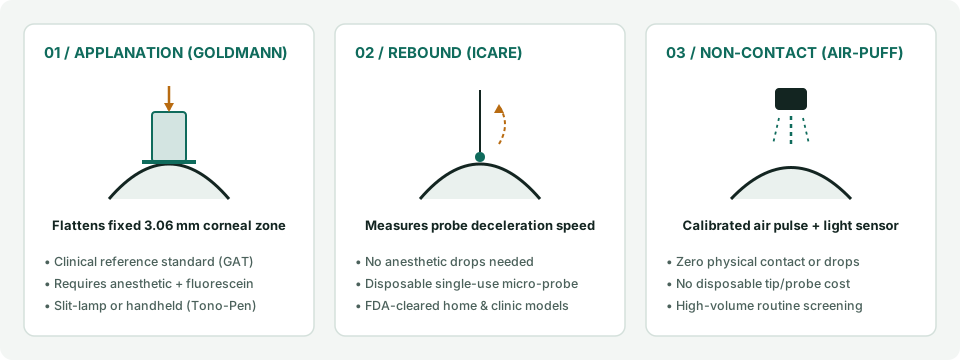
iCare HOME2 vs. ic100 vs. ic200: Complete Side-by-Side Comparison
Although all three instruments rely on rebound tonometry, they are built for very different operators and workflows. Buying an upright-only clinic model for bedridden patients—or paying for clinic hardware when a patient needs self-alignment guidance—leads to expensive regrets.
| Feature | iCare HOME2 (Patient Home) | iCare ic100 (Clinic Standard) | iCare ic200 (Clinic Flagship) |
|---|---|---|---|
| Target Operator | Patient self-use (Rx required) | Optometrist / Ophthalmologist / Tech | Ophthalmologist / ER / Surgical Suite |
| Verified New Price | $1,050 – $2,800+ | $3,500 – $4,800 | $4,500 – $6,000+ |
| Pre-Owned Range | Rental / DME programs common | $1,900 – $3,000 | $2,500 – $3,800 |
| Measurement Range | 10 – 60 mmHg | 7 – 50 mmHg | 7 – 50 mmHg |
| Stated Accuracy | ±1.5 mmHg | ±1.2 (≤20) / ±2.2 (>20 mmHg) | ±1.2 (≤20) / ±2.2 (>20 mmHg) |
| Patient Positioning | Sitting or supine (position-aware) | Sitting / standing upright only | 200° freedom (upright to full supine) |
| Alignment Assistance | Smart Light Guide + audio + auto R/L eye ID | EasyPos red/green alignment ring | High-visibility multi-angle probe light |
| Connectivity | Bluetooth LE → iCare PATIENT2 / MyEyes app | USB / standard clinic display | Bluetooth wireless + printing |
| Power Supply | 4 × AA alkaline batteries | 4 × AA alkaline batteries | 4 × AA alkaline batteries |
Deep Dive: iCare HOME2 for At-Home Glaucoma Monitoring
For patients diagnosed with glaucoma or high-risk ocular hypertension, the iCare HOME2 solved a decades-old limitation of eye care: single daytime snapshots in a doctor's office miss up to half of 24-hour IOP peaks.
What Works Well on the HOME2
- FDA 510(k) Clearance (K211355): Legally cleared in the United States for independent home self-tonometry in adults and children aged 8+ under a doctor's prescription.
- Self-Alignment Smart Light Guide: Because measuring your own eye without a mirror is tricky, the HOME2 illuminates a green ring when alignment and distance are correct and automatically detects whether you are measuring the right or left eye.
- Supine Self-Measurement: Unlike the first-generation iCare HOME, the HOME2 allows lying-down measurements, enabling patients to log early-morning pressure before getting out of bed.
- Cloud & App Syncing: Readings sync via Bluetooth to mobile apps so your ophthalmologist can review full multi-day pressure curves rather than handwritten notebooks.
Real Costs & Limitations Patients Must Know
- Insurance coverage is inconsistent: Even with a prescription, many U.S. health insurance plans treat home tonometers as non-covered or require prior authorization through a DME supplier. Short-term weekly or monthly rentals through ophthalmic monitoring services are often far more economical if your doctor only needs a 1- to 4-week diurnal profile.
- Probe budget: Plan for ongoing boxes of single-use sterile probes. High-frequency daily monitoring adds recurring supply costs over a year.
- Training curve: Clinical studies show over 75% of trained patients achieve reliable Goldmann-correlated readings, but patients with severe hand tremor, poor central fixation, or advanced arthritis may struggle without a caregiver's assistance.
Deep Dive: iCare ic100 vs. ic200 for Clinics
When to Choose the iCare ic100
If 95% of your patients sit upright in standard optometry exam chairs and you want fast, drop-free screening for adults and children without startling air puffs, the ic100 delivers the same ±1.2 mmHg (≤20 mmHg) precision as the ic200 at $1,000+ less upfront. Its EasyPos red/green light ring helps ophthalmic technicians collect repeatable series quickly.
When the iCare ic200 Is Worth the Upgrade
Step up to the ic200 if your clinic performs bedside consults, emergency triage, pediatric sedation exams, or post-operative surgical checks. Its 200-degree sensor allows true supine readings without tilting the patient's head awkwardly, while Quick Measure mode (2–3 rapid taps) shortens exams for restless children.
Honest Alternatives to Consider Before Buying iCare
- Need zero recurring probe costs in a busy optical shop? A desktop or wall-mounted non-contact air-puff unit (Topcon CT-800 or Keeler Pulsair) eliminates disposable probe expenses completely.
- Need readings over scarred or irregular corneas in ER/hospital work? The Reichert Tono-Pen AVIA uses a 1.0 mm micro-strain applanation tip that handles irregular corneal surfaces and bandage lenses reliably.
- Need the ultimate legal/clinical benchmark for glaucoma treatment decisions? Pair any handheld screening device with a slit-lamp Haag-Streit Goldmann AT 900 ($2,500–$3,000).