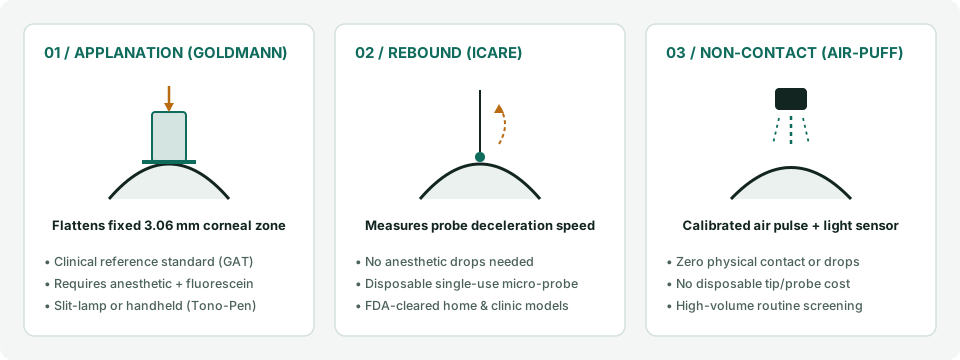
Master Comparison of the 5 Tonometer Categories
Choosing the right technology depends on whether you prioritize definitive glaucoma precision, zero-consumable screening speed, drop-free pediatric comfort, or home self-monitoring.
| Tonometer Type | Representative Models | Contact? | Numbing Drops? | Calibration | Typical Price | Primary Use Case |
|---|---|---|---|---|---|---|
| Goldmann Applanation (GAT) | Haag-Streit AT 900, Perkins Mk3 | Direct (3.06 mm prism) | Yes + fluorescein | Periodic verification | $2,200–$3,000 | Definitive glaucoma diagnosis & gold standard |
| Electronic Handheld Applanation | Reichert Tono-Pen AVIA / XL | Direct (1.0 mm covered tip) | Yes | None (AVIA) / Daily (XL) | $2,300–$5,400 | ER, bedside, irregular corneas, mobile clinics |
| Rebound Tonometry | iCare HOME2, ic100, ic200 | Brief micro-probe bounce | No | None required | $1,050–$6,000+ | Drop-free clinic screening, pediatrics, Rx home use |
| Non-Contact (Air-Puff / NCT) | Topcon CT-800, Keeler Pulsair | No physical contact | No | Automated self-check | $2,600–$13,000 | High-volume optometry screening, zero disposables |
| Indentation (Schiotz) | Mechanical Schiotz | Direct weighted plunger | Yes | Manual zero check | $150–$400 | Historical / resource-limited backup only |
1. Goldmann Applanation Tonometry (GAT) — The Clinical Gold Standard
Introduced in the 1950s and grounded in the Imbert-Fick principle, Goldmann applanation measures the exact force needed to flatten a fixed 3.06 mm diameter circle of the central cornea. At exactly 3.06 mm, tear-film capillary attraction roughly cancels out corneal bending resistance in an average cornea (~520–545 µm thick).
- Flagship hardware: The Haag-Streit Goldmann AT 900 ($2,500–$3,000) mounts directly onto a slit lamp (0–80 mmHg range, ±1.5% force deviation). For supine or mobile exams, the Perkins Mk3 ($2,200–$3,000) puts Goldmann optics into a handheld LED-lit body.
- Strengths: Highest clinical reproducibility and the benchmark used in virtually all major glaucoma trials.
- Limitations: Requires skilled alignment, topical anesthetic plus fluorescein dye, strict prism disinfection (or disposable prisms), and is affected by abnormal central corneal thickness (CCT) or high astigmatism.
2. Rebound Tonometry — Drop-Free Clinic & FDA-Cleared Home Monitoring
Rebound tonometers launch an ultra-lightweight, magnetized disposable probe momentarily against the cornea and track its deceleration rate via an induction coil. Higher intraocular pressure makes the eye stiffer, causing the probe to decelerate and rebound faster.
- Flagship hardware: iCare HOME2 (prescription home use), iCare ic100 (upright clinics), and iCare ic200 (200-degree multi-position ER/surgical clinics). See our full iCare Tonometer Comparison.
- Strengths: Completely painless without anesthetic drops, fast enough for anxious children, requires no routine clinic calibration, and currently offers the only widely prescribed FDA-cleared home self-tonometer in the U.S.
- Limitations: Requires a fresh disposable probe per patient/session and shows mild sensitivity to corneal biomechanics.
3. Non-Contact Tonometry (NCT / "Air-Puff Test")
Non-contact tonometers deliver a brief, metered puff of air toward the cornea while an electro-optical sensor detects the exact millisecond the cornea momentarily flattens. Modern units like the Topcon CT-800 ($4,500–$13,000) and Keeler Pulsair IntelliPuff / Desktop ($2,600–$8,500) modulate puff softness automatically to reduce patient startle.
- Strengths: Zero corneal contact, zero infection cross-contamination risk, zero numbing drops, and zero recurring disposable probe or tip-cover cost.
- Limitations: Less reliable than Goldmann for borderline glaucoma treatment changes and more prone to artifacts if a patient blinks or squeezes hard during the puff.
4. Handheld Electronic Applanation (Tono-Pen)
Devices like the Reichert Tono-Pen AVIA ($4,500–$5,400) and Tono-Pen XL ($2,300–$2,800) miniaturize applanation into a 1.0 mm electronic micro-strain gauge covered by a sterile Ocu-Film+ tip cover. Because they average multiple tiny taps and work at any angle, they are standard equipment in hospital emergency departments and corneal subspecialty clinics. Read the full Tono-Pen AVIA vs. XL Guide.
5. Indentation Tonometry (Schiotz) & Specialized Biomechanical Devices
- Schiotz indentation: Places a weighted metal plunger on a numbed supine cornea and reads indentation depth on a mechanical scale. Although inexpensive and battery-free, sensitivity to scleral rigidity and sterilization demands have retired it from routine modern clinics.
- Dynamic Contour & Ocular Response Analyzers (e.g., Pascal DCT, Reichert 7CR / ORA): Specialized clinical systems that measure corneal hysteresis or corneal-compensated IOP (IOPcc) to minimize corneal thickness bias in post-LASIK and complex glaucoma patients.