Tono-Pen AVIA vs. Tono-Pen XL: Side-by-Side Specification Table
Both the Reichert Tono-Pen AVIA and Reichert Tono-Pen XL share the same proven 1.0 mm micro-strain gauge applanation principle, averaging multiple independent corneal taps and displaying a statistical confidence indicator. Where they diverge is workflow speed, calibration overhead, battery economics, and price:
| Specification | Reichert Tono-Pen AVIA | Reichert Tono-Pen XL |
|---|---|---|
| Verified U.S. New Price | $4,500 – $5,400 | $2,300 – $2,800 |
| Measurement Technology | 1.0 mm micro-strain gauge (Quick-Tap) | 1.0 mm micro-strain gauge |
| Daily Calibration | Not required (factory calibrated) | Manual calibration check required |
| Display Layout | Dual large LCD screens (ambidextrous) | Single rear LCD screen |
| Battery System | Proprietary Powercel™ pack (~2,500+ exams) | Standard replaceable small batteries |
| Positional Flexibility | Any angle (upright or supine) | Any angle (upright or supine) |
| Topical Anesthetic | Required | Required |
| Sterile Consumable | Single-use Ocu-Film+ tip covers | Single-use Ocu-Film tip covers |
| Best Fit | High-volume clinics, ERs, multi-provider teams | Budget-conscious or lower-volume exam lanes |
How Tono-Pen Micro-Strain Gauge Applanation Works
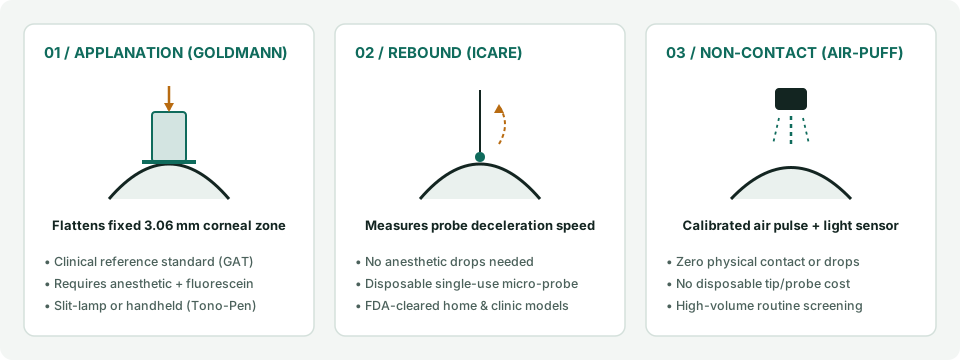
Unlike a slit-lamp Goldmann prism that flattens a 3.06 mm circle of the cornea manually, the Tono-Pen uses a microscopic 1.0 mm transducer tip shielded by a sanitized latex-free Ocu-Film+ cover. After instilling topical anesthetic drops, the clinician activates the unit with a single button push and gently taps the central cornea several times.
A built-in microprocessor analyzes the force-time waveform of each individual tap, rejects artifacts caused by off-axis touches or blinks, and outputs the averaged intraocular pressure in mmHg alongside a statistical confidence indicator (such as 95% on AVIA or percentage variance brackets on XL). Because the sensor is gravity-independent, readings work reliably whether a patient is sitting in an exam chair, reclining in a wheelchair, or lying flat on a hospital gurney.
Real-World Pros and Cons
Where Tono-Pen Excels
- Irregular, scarred, or edematous corneas: Its tiny 1.0 mm footprint can obtain usable readings on corneas where a 3.06 mm Goldmann prism produces distorted fluorescein mires, and even over soft bandage contact lenses in select clinical protocols.
- Emergency department & hospital consult readiness: Fits in a lab coat pocket, turns on instantly, and requires zero slit-lamp alignment—critical for ruling out acute angle-closure crises at the bedside.
- No daily calibration on the AVIA: Eliminates one of the most common technician friction points in multi-lane ophthalmology practices.
- Less sensitive to exact centration: Compared with earlier handheld rebound units, Tono-Pen tolerates slight corneal centration variance without rejecting the entire series.
Trade-Offs and Limitations
- Topical anesthetic is mandatory: Adds chair time and cannot be delegated in jurisdictions or settings where unlicensed screening staff are restricted from instilling diagnostic pharmaceutical drops.
- Ongoing consumable and battery spend: Every patient requires a fresh Ocu-Film+ cover, and the AVIA relies on Reichert's proprietary Powercel battery pack rather than off-the-shelf AA cells.
- Clinical variability at very high IOP: Like most handheld devices, Tono-Pen can slightly underestimate extreme pressures (>30–35 mmHg) or slightly overestimate low pressures compared with Goldmann applanation; clinicians still confirm pivotal glaucoma surgical decisions on a slit-lamp Goldmann unit when possible.
Tono-Pen AVIA vs. iCare ic100 / ic200: Which Handheld Should Your Clinic Buy?
Clinics shopping in the $3,500–$5,500 handheld bracket almost always cross-shop the Reichert Tono-Pen AVIA against the iCare ic100 ($3,500–$4,800) and iCare ic200 ($4,500–$6,000+). Here is the honest decision rule:
- Choose Tono-Pen AVIA if your practice handles frequent emergency room consults, corneal pathology/scarring, post-keratoplasty eyes, or bandage contact lens patients, and your clinicians already instill anesthetic drops routinely.
- Choose iCare ic100 or ic200 if your priority is drop-free pediatric exams, rapid technician screening without anesthetic, or patient comfort (no numbing sting, no air puff). Note that if you need supine/bedridden testing with iCare, you must step up to the ic200 rather than the upright-only ic100. Compare full iCare specs in our iCare Tonometer Guide.
- Choose Tono-Pen XL only if upfront capital budget is tightly capped near $2,500 and staff are disciplined about performing manual calibration checks.
Who Should NOT Buy a Tono-Pen
- Patients looking to test eye pressure at home: Never attempt self-tonometry with a Tono-Pen; improper technique under topical anesthetic risks corneal abrasion and infection.
- Optical shops that cannot legally administer anesthetic eye drops: Choose a drop-free rebound tonometer or a non-contact air-puff tonometer instead.